Trigger
War-ning

BA Final project
August 2025

Trigger War-ning is an interactive digital experience that translates traumatic memories from my military reserve service into a navigable system. Recorded sounds from the events activate visual disruptions across the interface: maps fragment, text becomes unstable, and present-day images are overtaken by the memories associated with each location. When the sound ends, the interface returns to a calm, static state mirroring the tension between the present and a past that can resurface without warning.
Role
Product Designer & Creator
Scope
Research, concept, UX/UI, visual language, vibe coding,
front-end development
Platform
Figma
Claude-code
Vercel
The Challenge
How might an interactive experience make the invisible reality of PTSD perceptible—without recreating the events literally or revealing information I was not allowed to share?
I wanted to create more than a record of what happened.
My goal was to let the viewer experience the instability of moving between two realities: the present moment and a traumatic memory that continues to feel immediate.
Traumatic memories are not always experienced as events that belong to the past. They can be triggered by a sound, image or place and return with the intensity of something happening in the present.
During EMDR therapy, I encountered bilateral stimulation—repetitive movement or sound that shifts from side to side while a traumatic memory is being processed. The movement between past and present, disruption and regulation, became a foundation for the interaction and visual language of the project.
Designing Under Constraints
After one of my therapy sessions, I noticed a flickering screen that appeared broken but continued to transmit as usual. It gave me a visual metaphor for what I was experiencing: a system that still functions while something inside it remains disrupted.
From there, REM became RAM—human memory translated into computer memory. Present-day photographs were interrupted by images from my reserve service. The northern landscape I had known throughout my life became fragmented by events that changed the way I experience those places.
I remember these moments with very little color, almost like an old film. Glitch, distortion and broken pixels became more than an aesthetic choice; they became a way to represent the collision between what exists in front of me and what I continue to see.

A central constraint was finding a way to tell the story without reproducing protected military information or depicting every event literally. ASCII offered a language of abstraction. It allowed me to break maps and images into characters, pixels and fragments—preserving the structure and emotional trace of a place while distancing the representation from documentary realism. What began as a limitation became one of the project’s defining visual principles.
The Product Concept
IDF operatioms system
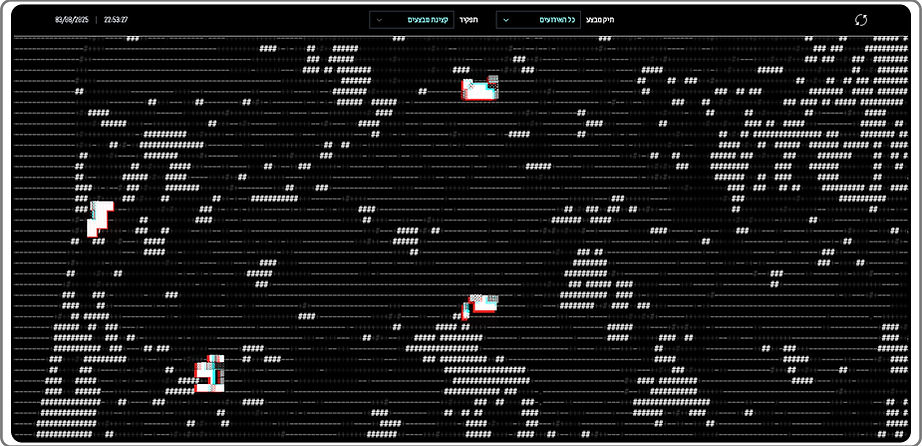
product design & interactions
event quick look


event quick look

session onboarding

events pop-up

>start
Outcome
The project resulted in a fully functional interactive web experience, presented as a self-guided installation.
It brought together documentary audio, an ASCII-based map, present-day photography and real-time visual distortion to create a narrative that could not be communicated through a static medium alone.Although the experience currently contains four personal memories, I designed its underlying structure to support additional locations, recordings and testimonies. This opened a possible future direction for the project: a shared platform through which other veterans could communicate experiences that are often difficult to describe in words.
Trigger War-ning was later officially selected for the Digital Works program at the Tel Aviv International Student Film Festival.